
What Food, Pharma and Nutraceutical Buyers Must Know
2026 EU Additive Amendments: What Citrate Buyers Should Know Commission Regulations (EU) 2026/189 and 2026/196 entered into force on 18 February 2026. Regulation 2026/196 introduces mandatory microbiological criteria for hydrocolloids and E1450 used in infant foods and FSMP. Citrates (E331 to E333) are not directly amended, but the regulation establishes a clear industry direction that progressive buyers are already applying to all additive suppliers including citrate manufacturers.
The European Citrate Market: Size, Scope and Stakes
Europe is the world’s largest single market for citric acid and citrate salts, accounting for approximately 45 percent of global market share. The continent’s strict regulatory framework, high food safety standards, and advanced pharmaceutical manufacturing base drive consistent, high-value demand for quality-certified ingredients. For Asian manufacturers with WHO-GMP credentials, the EU represents the most rewarding export destination in the world.
Yet that same regulatory rigour creates significant compliance complexity. Procurement managers at European food, pharma, and nutraceutical companies must navigate a layered framework of Union legislation, pharmacopoeial standards, and sector-specific guidance documents. The 2026 amendments to the food additive regulations represent the most consequential update to this framework in several years.
|
| 2.93M tonnesGlobal citric acid volume in 2025 | 5.8% CAGREU sodium citrate market growth rate |
The EU pharmaceutical excipient market is particularly important for citrate suppliers. Sodium citrate, potassium citrate, and calcium citrate are widely used across tablet buffering, parenteral formulations, oral liquids, and lyophilised products. Demand is further buoyed by the electrolyte supplement boom, with organic mineral salts commanding a premium in functional foods and sports nutrition formats now mainstream across Germany, the Netherlands, France, and the UK.
Market Intelligence NoteThe global hydration beverage market is projected to exceed $82 billion by 2035, with organic citrate salts (sodium, potassium, calcium, magnesium) central to electrolyte formulations. European nutraceutical buyers are increasingly demanding Ph. Eur.-compliant, fully traceable citrate ingredients to satisfy both regulatory and clean-label requirements. |
Why the EU Just Updated Its Food Additive Rules
The European Food Safety Authority (EFSA) has been conducting a systematic re-evaluation of all food additives currently authorised under Regulation (EC) No 1333/2008 since 2010. This programme, mandated by Regulation (EU) No. 257/2010, has methodically reviewed each additive against updated scientific evidence, applying modern risk assessment methodology to specifications that in some cases had not been scrutinized since the 1990s.
The January 2026 amendments represent the outcome of recent EFSA re-evaluations specifically focused on product categories consumed by vulnerable populations. Scientific panels concluded that while the widely used citrate salts (E331 to E333) remain safe for general food applications, specific applications in infant formula, follow-on formula, processed cereal-based foods, and Foods for Special Medical Purposes warranted tightened microbiological specifications and updated purity criteria. The commission acted swiftly to translate those scientific opinions into binding legislation.
This is not a niche regulatory tweak. Any company manufacturing, importing, or using food-grade citrate salts in the EU must review whether their current supply arrangements remain compliant. The August 2026 deadline is only months away.
What Changed: The Two Key Regulations
Two commission regulations were published together on 29 January 2026. They work in concert: one updates the authorised uses list, the other updates the technical specifications that define the identity and purity of the additives themselves.
Regulation | Title | Key Points |
|---|---|---|
Commission Regulation (EU) 2026/189 | Shellac and FSMP Authorisations | • Published on 29 January 2026, in force from 18 February 2026 • New authorised uses for glazing agents in FSMP tablets • Technical specification amendments to Regulation (EU) No 231/2012 • Introduces Shellac (E 904) as a glazing agent for FSMP coated tablets • Affects all formulated food for special medical purposes |
Commission Regulation (EU) 2026/196 | Vulnerable Populations – Additive Restrictions | • Published on 29 January 2026, in force from 18 February 2026 • Mandatory microbiological criteria: absence of Salmonella spp. and Cronobacter spp .• Revised purity specifications for several E numbers including E331, E332, E333 • Compliance deadlines between August 2026 and February 2028 • Transitional provisions for stocks lawfully placed on market before August 2026 |
The Microbiological Safety Requirement in Detail
The headline change under Regulation (EU) 2026/196 is the mandatory microbiological testing requirement for food additives destined for vulnerable population product categories. The specific criteria introduced are:
- Absence of Salmonella in 25g of the additive per batch
- Absence of Cronobacter in 10g of the additive per batch
Cronobacter sakazakii is a particular concern in infant nutrition due to the organism’s association with severe neonatal meningitis and necrotising enterocolitis. The inclusion of Cronobacter as a mandatory test criterion specifically for additives destined for infant formula reflects the highest level of regulatory caution and aligns EU food additive standards with the microbiological criteria already applied to infant formula base ingredients.
For suppliers, this means microbiological testing must now be performed and documented on a per-batch basis where citrate salts are sold into infant food or FSMP applications. Generic annual certificates of analysis are no longer sufficient for these product categories.
Revised Purity Specifications: What to Expect
Beyond microbiological criteria, the amended Regulation (EU) No 231/2012 updates the technical specifications for a number of additives, including citrates. Key areas of revision include limits on heavy metal impurities, specifications for residual solvents where relevant, and more granular identity testing requirements aligned with current pharmacopoeial standards. European buyers should request updated CoA templates from their suppliers that explicitly cross-reference the post-2026 specification requirements.
Compliance Timeline
Understanding the phased implementation schedule is critical for procurement teams planning reformulation or supplier qualification activities:
Timeline | Milestone | Details |
|---|---|---|
January 2026 | Regulations Published | Commission Regulations (EU) 2026/189 and 2026/196 were published in the Official Journal of the EU on 29 January 2026. Immediate review of supply arrangements is recommended. |
February 2026 | Entered Into Force | Both regulations entered into force on 18 February 2026. Companies should have commenced compliance gap assessments and initiated supplier qualification reviews. |
August 2026 | First Compliance Deadline | Products not compliant with the new specifications for infant food and FSMP applications may no longer be placed on the EU market after this date, subject to transitional provisions for existing stocks. |
February 2028 | Full Compliance Required | All remaining transitional provisions lapse. Full compliance with all updated additive specifications is mandatory across all affected product categories. No further grace periods apply. |
Which Citrate Applications Are Affected?
The impact of the 2026 amendments varies depending on the citrate salt, its grade, and its intended application. The table below provides a rapid reference for procurement and regulatory affairs teams:
E Number | Citrate Salt | Common EU Applications | 2026 Compliance Impact |
E331 | Sodium Citrates | Infant formula, FSMP, beverages, dairy, pharma excipient, parenteral solutions | High impact. Mandatory microbiological criteria for infant and FSMP applications. Revised Ph. Eur. alignment required. |
E332 | Potassium Citrates | Infant foods, nutraceuticals, electrolyte drinks, oral pharmaceutical solutions | High impact. Same microbiological requirements apply. Widely used in rehydration products and infant cereals. |
E333 | Calcium Citrates | Fortified foods, infant cereals, FSMP, dietary supplements, dairy alternatives | High impact. Particularly significant for infant cereal and calcium-fortified FSMP applications. |
E330 | Citric Acid | Universal food acidulant, beverages, preservatives, cleaning formulations | Medium impact. General food use largely unaffected. Infant and FSMP applications subject to the same scrutiny. |
Industry-by-Industry Compliance Guide
The 2026 amendments touch different sectors with different degrees of urgency. Here is a sector-specific breakdown of what compliance means in practice.
Infant Nutrition Manufacturers
Infant formula and follow-on formula manufacturers face the most immediate and stringent requirements. The new Cronobacter and Salmonella criteria apply directly to the citrate salts used as buffers and pH regulators in these products. Manufacturers should:
- Audit current citrate supplier CoA templates against post-February 2026 specifications
- Request per-batch microbiological certificates for Salmonella and Cronobacter from all citrate suppliers
- Update quality agreements and supplier qualification documentation to reflect new criteria
- Review product labels and technical dossiers if reformulation is required
- Confirm that all citrates used in powdered infant formula comply by the August 2026 deadline
Pharmaceutical Excipient Buyers
Pharmaceutical manufacturers and contract development organisations (CDOs) using citrate salts as excipients in EU-marketed medicines need to verify whether their current pharmaceutical-grade citrate suppliers meet the updated Regulation (EU) No 231/2012 specifications. Key actions include:
- Verify supplier Ph. Eur. monograph compliance against the 2026 revised specifications
- Request updated pharmaceutical impurity profiles and residual solvent declarations
- Confirm WHO-GMP or EU GMP certification is current and listed in EudraGMDP where applicable
- Review existing Certificates of Suitability (CEP) from EDQM if applicable to the citrate grade used
- Update Drug Master File (DMF) excipient documentation if regulatory submissions reference the old specifications
Food and Beverage Manufacturers
For mainstream food and beverage applications, the 2026 amendments have limited direct impact unless the products target infant or paediatric consumers. However, this is a good opportunity for procurement teams to future-proof their supplier documentation. Recommended actions:
- Confirm current CoAs reference EU No 231/2012 as amended in 2026
- Obtain updated supplier declarations of compliance with Regulation (EC) No 1333/2008
- Request allergen, GMO, and country of origin declarations if not already on file
- Consider requesting BSE/TSE declarations even where not currently required, as a supply chain resilience measure
Nutraceutical and Dietary Supplement Manufacturers
The nutraceutical sector sits at the intersection of food and pharmaceutical regulations. Citrate mineral salts (potassium citrate, magnesium citrate, calcium citrate, zinc citrate) are central to electrolyte, bone health, and cognitive supplement formulations. Companies selling into the EU market should ensure:
- Citrate salts used in products for children or infants meet the new microbiological criteria
- Mineral citrate grades meet EU FCC, Ph. Eur., or applicable national pharmacopoeial standards
- Product notifications filed under the relevant member state frameworks remain consistent with supplier documentation
- Clean-label and traceability claims are backed by full batch documentation from the citrate supplier
Foods for Special Medical Purposes (FSMP) Producers
FSMP producers face a dual burden: the new Regulation (EU) 2026/189 directly affects authorised uses within this category, while Regulation (EU) 2026/196 imposes the microbiological criteria that also apply to infant foods. Companies manufacturing tube feeds, oral nutritional supplements, and metabolic disease products should treat this as a high-priority compliance event and engage their regulatory affairs teams and citrate suppliers simultaneously.
Documentation Checklist for EU Citrate Buyers
When sourcing citrates from any supplier for the European market post-February 2026, request and verify the following documents. This checklist applies to every onboarding and annual supplier review:
✓ | Certificate of Analysis (CoA) Aligned with Ph. Eur. (European Pharmacopoeia) or FCC (Food Chemicals Codex) specifications. Must reflect post-2026 revised purity and identity parameters. |
✓ | Microbiological Test Report Per-batch report confirming absence of Salmonella spp. (25g) and Cronobacter spp. (10g). Mandatory for infant food and FSMP applications from August 2026. |
✓ | WHO-GMP or EU GMP Certificate Current certificate from a recognised authority. For pharmaceutical excipients, verify listing in the EudraGMDP database. Certificate must not be expired. |
✓ | MSDS / Safety Data Sheet EU REACH-compliant format per Regulation (EC) No 1907/2006. Must include Section 3 composition, Section 8 exposure controls, and Section 14 transport information. |
✓ | BSE/TSE Declaration Written declaration confirming no bovine, ovine, or caprine materials are used in production or processing. Critical for pharma, infant nutrition, and FSMP sectors. |
✓ | Declaration of Compliance with Regulation (EC) No 1333/2008 as amended Supplier declaration confirming the citrate salt meets the Union list of approved food additives as updated by the 2026 amendments, including revised specifications under Regulation (EU) No 231/2012. |
✓ | Allergen, GMO and Country of Origin Declaration Required under EU food information and traceability legislation. Particularly important for fermentation-derived citric acid and citrate salts where the carbon source may be subject to GMO rules. |
✓ | Halal and Kosher Certification (where applicable) Increasingly required by European nutraceutical, food, and pharmaceutical manufacturers serving multi-faith markets. Confirm scope of certification covers the specific citrate grade. |
Sourcing Strategy: European vs. International Citrate Suppliers
A recurring question among EU procurement managers is whether to source citrates from European manufacturers or from qualified international suppliers. The 2026 regulatory changes do not create any preference for European origin in the legislation. What matters is product quality, documentation integrity, and the supplier’s ability to meet the technical specifications. This section examines both options objectively.
The Case for European Manufacturers
- Shorter lead times – Domestic or intra-EU sourcing reduces transit time and simplifies logistics planning
- Currency stability – EUR-denominated pricing eliminates exchange rate exposure for EU buyers
- Audit accessibility – Facility audits are easier to schedule and less costly to execute
- Regulatory proximity – Some European suppliers have long-standing relationships with national competent authorities
- Sustainability credentials – Several European producers use bio-based fermentation processes from regional agricultural feedstocks
The Case for International WHO-GMP Certified Manufacturers
- Production scale – Asian manufacturers typically operate at significantly higher volumes, enabling supply chain continuity for large-scale buyers
- Competitive pricing – Lower input and labour costs translate to better economics, particularly for commodity-grade applications
- Documentation depth – Leading WHO-GMP certified manufacturers in India produce documentation packages that match or exceed European standards
- Grade breadth – Large-scale producers offer the full citrate range (food, pharma, Ph. Eur., USP, FCC) from a single source, simplifying supplier management
- Regulatory equivalence – WHO-GMP certification is formally recognised across the EU for food additive imports; EudraGMDP listings are achievable for pharmaceutical-grade products
Key Point for Procurement TeamsThe 2026 EU amendments apply equally to citrates of any origin. A WHO-GMP certified Indian manufacturer producing to Ph. Eur. specification with full microbiological documentation is equally compliant with the new regulations as a European manufacturer. Origin is not a compliance criterion. Documentation quality and product specification are. |
Understanding EU GMP vs. WHO-GMP: What Buyers Should Know
Confusion between EU GMP and WHO-GMP is common in procurement teams, particularly where the same product may be used across both food and pharmaceutical applications. The distinction matters for qualification and documentation purposes.
EU GMP | Details |
| Scope | Pharmaceutical manufacturing sites and active substance manufacturers supplying the EU market |
| Legal basis | Directive 2001/83/EC, Commission Delegated Regulation (EU) 2017/1569, and EU GMP Guidelines |
| Verification | EudraGMDP database (publicly searchable at eudragmdp.ema.europa.eu) |
| Issued by | EU national competent authorities following formal GMP inspection |
| Best suited for | Pharmaceutical excipients, APIs, and ingredients destined for EU-marketed medicines |
WHO-GMP | Details |
| Scope | Pharmaceutical and food-grade manufacturing sites globally, covering medicines and food-grade ingredients |
| Legal basis | WHO Technical Report Series guidelines, adopted by participating countries |
| Verification | WHO-GMP certificate issued by national medicines regulatory authority (e.g. CDSCO in India) |
| Issued by | National regulatory authorities following WHO-standard inspection |
| Best suited for | Food additives, pharmaceutical excipients, and WHO pre-qualified products exported to regulated markets |
For food-grade citrate additives (E331, E332, E333) used in standard food manufacturing, WHO-GMP certification combined with FSSC 22000 or ISO 22000 is sufficient for import and use in the EU. The product simply needs to meet the technical specifications of Regulation (EU) No 231/2012 as amended and be used within the authorised categories and limits of Regulation (EC) No 1333/2008.
For pharmaceutical excipients used in EU-licensed medicinal products, EU GMP Part II alignment (based on the IPEC-PIC/S Good Manufacturing Guide) is increasingly expected by marketing authorisation holders during supplier qualification audits. An EDQM Certificate of Suitability (CEP) provides the highest level of assurance for Ph. Eur. monographed excipients and streamlines the regulatory file for the finished medicine. Daffodil Pharmachem’s WHO-GMP certification covers our pharmaceutical excipient production environment, and we support EU GMP audit requests with full site master files and quality agreements.
How Daffodil Pharmachem Supports EU Compliance
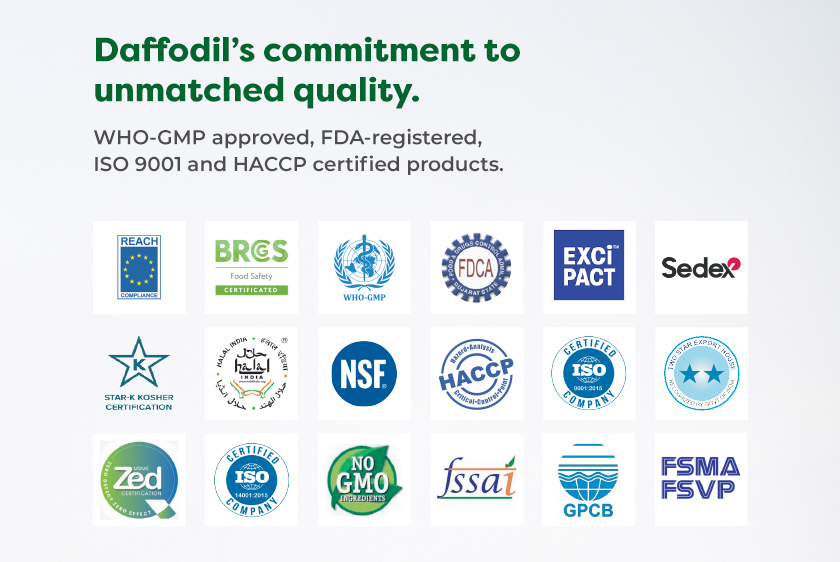
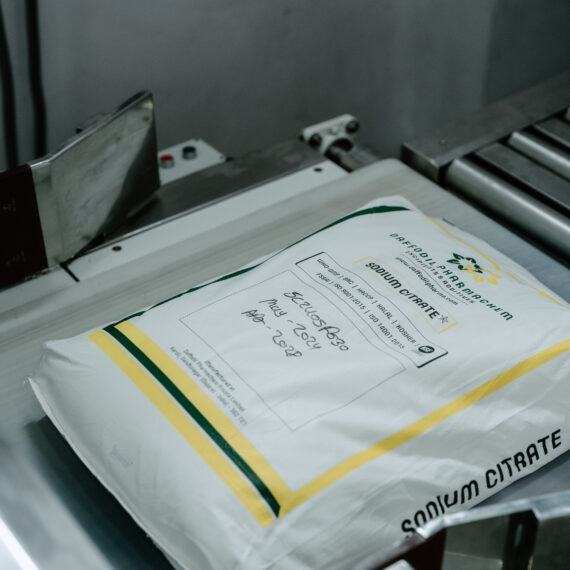
As Asia’s largest WHO-GMP certified citrate manufacturer, Daffodil Pharmachem has built its EU export programme around the documentation standards and technical specifications that European buyers require. Our DaffoCitra brand covers the complete range of citrate salts produced to Ph. Eur., USP, BP, and FCC standards, with batch-level traceability from raw material sourcing through finished product release and export documentation.
The Daffodil Pharmachem Portfolio
Product | Grades Available | Key EU Applications | Ph. Eur. Monograph |
| Sodium Citrate Dihydrate | Ph. Eur., FCC, Food, Pharma | Infant formula, FSMP, parenteral, beverages | Sodium citrate (0482) |
| Potassium Citrate Monohydrate | Ph. Eur., USP, BP, FCC | Electrolytes, oral pharma, nutraceuticals | Potassium citrate (0400) |
| Calcium Citrate Tetrahydrate | Ph. Eur., FCC, Food | Infant cereals, supplements, fortified foods | Calcium citrate (1185) |
| Magnesium Citrate | Ph. Eur., Food | Nutraceuticals, sports nutrition, pharma | Magnesium citrate (2401) |
| Zinc Citrate | FCC, Food | Mineral fortification, infant nutrition | FCC specification |
| Citric Acid Anhydrous | Ph. Eur., USP, FCC, Food, Pharma | Universal acidulant, preservative, buffering | Citric acid, anhydrous (0459) |
| Citric Acid Monohydrate | Ph. Eur., USP, FCC, Food | Beverages, food processing, pharma | Citric acid monohydrate (0147) |
Our Standard EU Documentation Package
- Batch-specific Certificate of Analysis (CoA) with full Ph. Eur. / FCC parameter set
- Microbiological report: Total Plate Count, yeast and mould, Salmonella, E. coli, Cronobacter spp. on request
- WHO-GMP compliance certificate (current)
- BSE/TSE declaration
- Allergen and GMO declaration
- EU-format Safety Data Sheet (REACH compliant)
- Halal and Kosher certificates (available for all grades)
- REACH-compliant packaging and labelling documentation
- Quality Agreement templates for pharmaceutical and food-grade supply
- Site Master File excerpt available for EU GMP audit support
Step-by-Step Compliance Action Plan for EU Buyers
The following action plan is designed for regulatory affairs and procurement professionals who need to confirm supply chain compliance with the 2026 amendments before the August 2026 deadline.
Step 1 | Map Your Citrate ApplicationsList every product in your portfolio that uses a citrate salt (E330, E331, E332, E333). Flag any that are intended for infants, young children, or patients using FSMP. These products carry the highest compliance urgency. |
Step 2 | Contact Each Citrate SupplierSend a formal supplier questionnaire requesting: updated CoA against the 2026 revised specifications, per-batch microbiological test capability for Salmonella and Cronobacter, current GMP certificate, and an updated Declaration of Compliance with Regulation (EC) No 1333/2008 as amended by 2026/196. |
Step 3 | Review and Gap-Assess DocumentationCompare received documentation against the checklist in Section 7 of this guide. Identify gaps: missing microbiological data, expired GMP certificates, CoAs that do not reference the revised 2026 specifications, or allergen declarations that are absent or out of date. |
Step 4 | Qualify Compliant SuppliersFor any supplier unable to meet the documentation requirements, initiate parallel qualification of an alternative compliant source. Do not wait until the August 2026 deadline to identify supply gaps. Qualification timelines of 8 to 12 weeks are typical for food-grade citrates; pharmaceutical-grade may take longer. |
Step 5 | Update Internal DocumentationRevise product technical files, specification sheets, and regulatory submissions to reflect the updated supplier documentation. If products are registered under EU Member State food supplement or FSMP notification frameworks, assess whether notifications require amendment. |
Step 6 | Complete Before August 2026Ensure all infant food and FSMP product lines are using compliant citrate ingredients before 18 August 2026. Retain documentation of compliance actions taken. Be prepared to demonstrate your compliance process to competent authorities if required. |
EU Country Market Spotlights: Priority Destinations for Citrate Exports
Three EU markets stand out as the highest-priority destinations for citrate salt exports from WHO-GMP certified manufacturers. Each has distinct characteristics in terms of buyer profile, regulatory stringency, and procurement culture.
DE GermanyLargest EU pharmaceutical ingredients importerGermany is Europe’s largest pharmaceutical manufacturer and one of the world’s most demanding markets for ingredient quality. German buyers place exceptional importance on complete documentation packages, traceability, and GMP certification status. The German pharmaceutical industry is regulated under Arzneimittelgesetz (AMG) and strictly aligned with EU GMP standards. Food manufacturers in Germany are equally rigorous, with FSSC 22000 certification widely expected from ingredient suppliers. • Ph. Eur. compliance is a baseline requirement for all pharma-grade citrates • EDQM Certificates of Suitability (CEP) are strongly preferred for EU-market pharmaceutical excipients • German food buyers frequently request additional documentation including supplier sustainability reports • Key sectors: pharmaceuticals, infant nutrition, sports and clinical nutrition |
NL NetherlandsStrategic EU trade hub and pharma manufacturing centreThe Netherlands hosts several of Europe’s largest pharmaceutical and food ingredient distribution hubs, and is a primary EU port of entry for ingredients imported from Asia. Dutch procurement teams are sophisticated and price-competitive, but prioritise supply chain reliability and documentation depth. The Netherlands is also home to a concentration of infant formula and clinical nutrition manufacturers who will be most directly impacted by the 2026 microbiological criteria. • Rotterdam-based distribution makes the Netherlands a natural logistics hub for EU-wide citrate distribution • Dutch infant nutrition manufacturers are among the most demanding citrate buyers in Europe • Netherlands Food and Consumer Product Safety Authority (NVWA) is known for rigorous customs documentation checks • Key sectors: infant formula, clinical nutrition, food ingredients distribution |
BE BelgiumHome of Citribel and the EU regulatory institutionsBelgium hosts Citribel, a domestic citric acid producer, as well as major EU institutions including the European Commission and EFSA’s administrative presence. Belgian pharmaceutical and food companies are therefore highly attuned to regulatory developments and tend to be early adopters of compliance best practices. The country is also a gateway for French-speaking EU markets including Luxembourg and parts of Switzerland. • Citribel’s local presence creates price anchoring; international suppliers must compete on quality and documentation • Belgian food additive buyers are among the first in Europe to implement regulatory changes • FASFC (Federal Agency for the Safety of the Food Chain) is a proactive enforcement body • Key sectors: food and beverage manufacturing, pharmaceuticals, nutraceuticals |
Need EU-Compliant Citrates for Your Supply Chain?
Our team can prepare a complete documentation package tailored to your EU regulatory requirements: CoA, GMP certificates, microbiological reports, BSE/TSE declarations, and more.
Contact: info@daffodilpharma.com | www.daffodilpharma.com

 English