
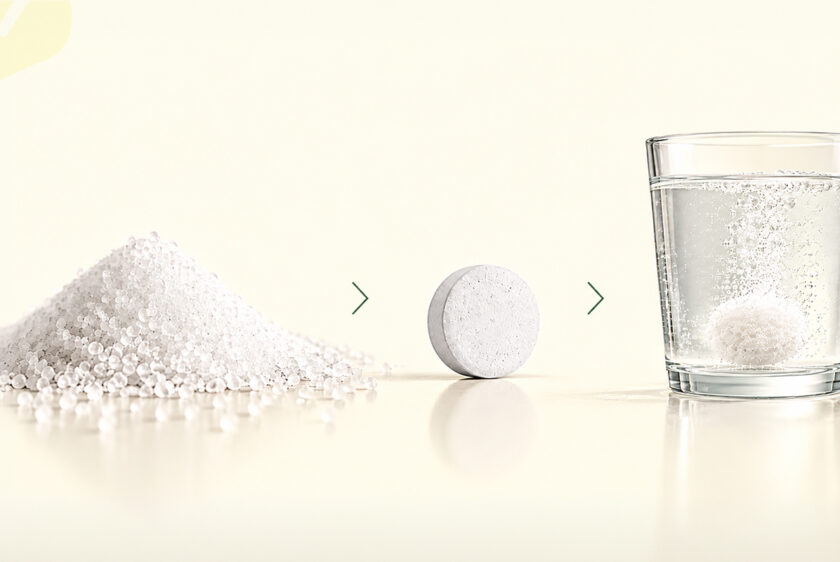
A practical guide to flow, compaction, moisture management, and the sourcing questions that matter in effervescent manufacturing.
|
THE FORMULATION REALITY Reliable effervescence is not just chemistry. It is chemistry engineered for the way a material flows, compacts, stores and performs. |
THE STARTING POINT
Particle behavior starts before the press
In tablet manufacturing, particle behavior can be as important before the press as it is during compression. Fine citric acid powders can present challenges with flowability, handling, and compaction, particularly when their particle characteristics are not well suited to high-speed processing. That is where granulation earns its place. As a particle-engineering step, it can increase particle size, improve flow and density characteristics, and create a material that is easier to handle through downstream processing.
For effervescent formulations, those characteristics become even more important. Citric acid is commonly used as the acidic component of an effervescent system. When it comes into contact with water in the presence of a carbonate or bicarbonate- most commonly sodium bicarbonate – an acid-base reaction releases carbon dioxide.
PROCESS PERFORMANCE
Why granulate citric acid?
Better flow and more predictable processing
Direct compression works best when the material entering the tablet press has suitable flow and compaction properties. Fine or cohesive powders can make hopper discharge and consistent die filling more difficult. Granulation enlarges particles and can improve powder flow, density, and handling characteristics. For formulators, that can translate into a more predictable material during blending, transfer, and compression.
Improved processing and compaction behavior
Good flow is only part of the job. A tablet blend also needs to compact into tablets with the required mechanical strength without creating excessive sticking, segregation or ejection problems.
When a raw powder is not ideally suited to direct compression, granulation gives formulators another way to engineer the physical properties required for reliable downstream processing.
Managing one of effervescence’s biggest challenges: Moisture
|
A SIMPLE RULE Effervescence is meant to happen in the glass – not in the hopper, blender or pack. |
Ambient moisture can initiate a premature acid-base reaction, contribute to sticking and caking, and ultimately affect product stability and performance. Moisture management therefore needs to be treated as a system-level requirement.
Raw-material selection, granule design, coating where applicable, controlled processing humidity, suitable packaging and appropriate storage conditions all contribute to protecting the formulation until use.
APPLICATIONS
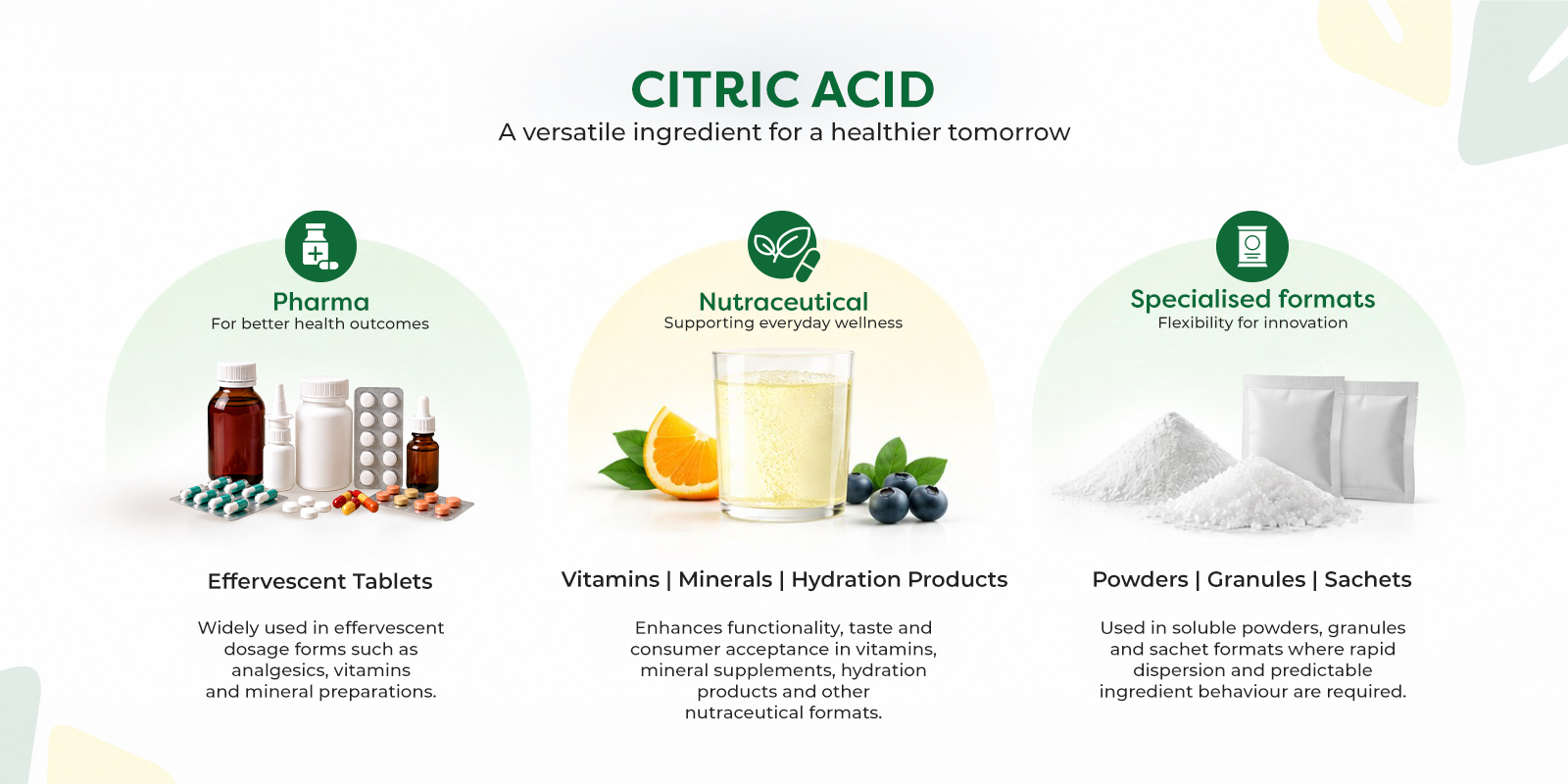
Where effervescent citric acid systems are used
Pharmaceutical formulations
Citric acid is widely used in effervescent dosage forms for products such as analgesics, vitamins, and mineral preparations. Because an effervescent tablet is dissolved or dispersed before administration, it can enable rapid dissolution of the active ingredient. For certain APIs and formulations, this may also support faster absorption or onset of action compared with a conventional tablet.
The format can also offer a more convenient administration option for consumers or patients who find conventional tablets difficult to swallow.
Nutraceuticals and functional nutrition
Effervescence is equally relevant in vitamins, mineral supplements, hydration products, and other nutraceutical formats. Here, performance is both functional and sensory. Rapid dispersion, taste, mouthfeel, and a consistent effervescent experience can all influence consumer acceptance.
Powders, sachets, and specialized formulations
The same acid-base chemistry is used in soluble powders, granules, and sachet formats where rapid dispersion and predictable ingredient behaviour are required. For manufacturers, choosing an appropriate citric acid grade is therefore both a formulation decision and a processing decision.
BUYER CHECKLIST
What should formulators check before sourcing?
| LOOK BEYOND THE COA
A COA can tell you what is in the material. It does not always tell you how that material will behave in your process. |
Depending on the application and manufacturing route, formulators and procurement teams should look beyond the ingredient name and assess the physical, quality and documentation parameters that matter to their process.
| ✓ Particle-size distribution – because particle characteristics can influence flow, mixing, processing and dissolution. | ✓ Bulk and tapped density – particularly where consistent feeding, filling or compression is important. |
| ✓ Moisture or water specification – given the moisture sensitivity of effervescent systems. | ✓ Flow and compaction data – where relevant to the intended manufacturing process. |
| ✓ Assay and impurity profile – in line with applicable quality requirements. | ✓ Pharmacopoeial compliance – based on the destination market and end use. |
| ✓ Lot-to-lot consistency – especially for critical physical properties. | ✓ COA, TDS and SDS documentation – together with relevant regulatory and quality certifications. |
| ✓ Packaging and storage recommendations – particularly where moisture protection is critical. | |
| THE SOURCING QUESTION
In effervescent manufacturing, the question is not simply whether the ingredient is citric acid. It is whether the grade behaves the way your process needs it to. |
|
PRECISION. QUALITY. SUPPLY CONFIDENCE.
Where Daffodil Pharmachem fits

Daffodil Pharmachem manufactures citrate ingredients, including pharmaceutical-grade anhydrous citric acid and monohydrate citric acid.
Its WHO-GMP-certified manufacturing facility spans 500,000 sq. ft. and uses SCADA-controlled systems. The company reports a production capacity of more than 80 metric tonnes of citrate ingredients per day, supported by in-house chemical and microbiological testing and a supply footprint spanning more than 25 countries.
|
WHO-GMP CERTIFIED FACILITY |
500,000
SQ. FT. FACILITY |
80+
METRIC TONNES / DAY |
|
THE PARTNERSHIP VIEW For a formulator, chemistry may get an ingredient onto the shortlist. Consistency, documentation, and confidence in supply are what keep it there. |
||
|
RIGHT CHEMISTRY. RIGHT CONSISTENCY. RIGHT PARTNER. TALK TO DAFFODIL PHARMACHEM Explore citric acid solutions for your formulation. daffodilpharma.com |
Chemistry is more than science.
It is a way of Adding Life.



 English