
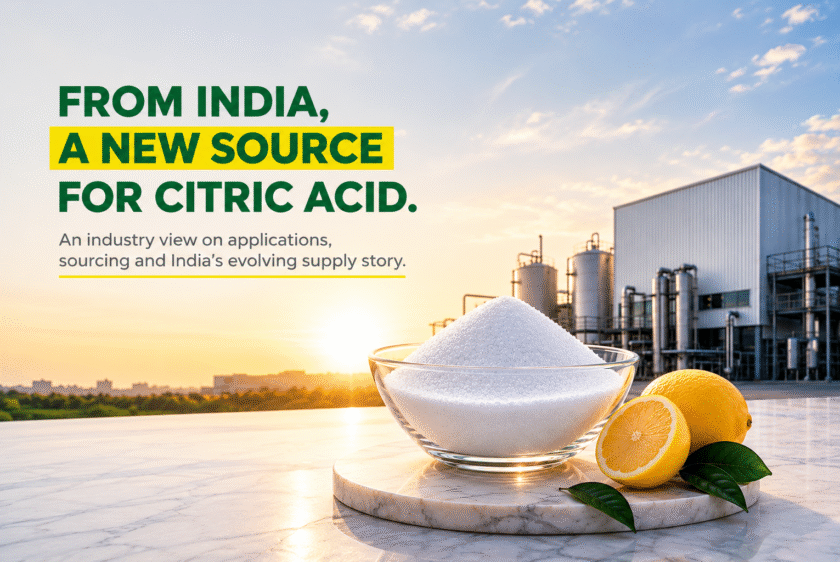
Beyond the Molecule: Why the Source of Citric Acid Matters
01 THE INGREDIENT
The ingredient most people notice only when it is missing
Citric acid is easy to associate with lemons, limes and that familiar sharp taste.
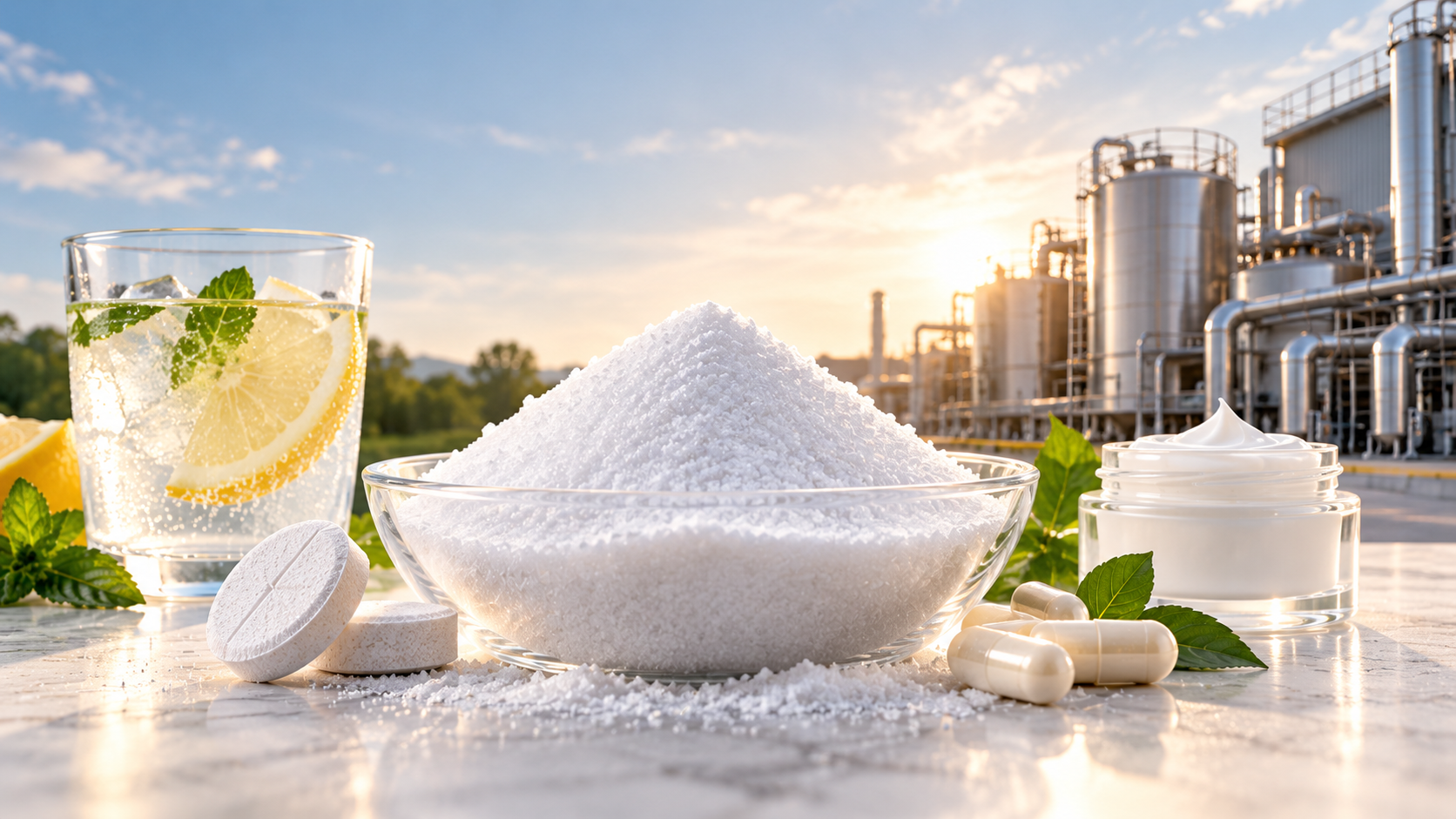
But in modern industry, its role is much broader. Citric acid is a widely used organic acid that can help control acidity, support flavour, assist with preservation systems and bind certain metal ions. In food applications, these functions make it useful across beverages, confectionery, processed foods and other formulations. Regulatory references also recognise citric acid for functions including flavour enhancement, pH control and sequestration.
In pharmaceuticals, citric acid can be used in formulations where acidity, buffering and effervescence matter. In cosmetics and personal care, it can play a role in pH adjustment and chelation. Its properties also make it useful in cleaning and industrial applications.
|
ONE MOLECULE. MANY ROLES. |
That is what makes citric acid interesting. It is one ingredient, but it can perform very different jobs depending on the product around it.
|
A USEFUL WAY TO LOOK AT IT The ingredient itself is only part of the story. How it is specified, documented, and supplied can matter just as much to the manufacturer using it. |
02 ACROSS INDUSTRIES
Why one ingredient serves so many industries
The chemistry stays the same. The job changes with the formulation.
|
● Food & Beverage Used as an acidulant and flavour-support ingredient across drinks, confectionery, jams and processed foods. |
● Pharmaceuticals
Used where acidity, buffering or effervescence are important to the finished dosage form. |
● Nutraceuticals
Relevant in supplements and effervescent formats where formulation behaviour and product stability matter. |
|
● Personal Care & Cosmetics Can support pH adjustment and chelation in skincare, haircare and cleansing formulations. |
● Home Care
Useful in cleaning and descaling applications because of its acidity and metal-binding behaviour. |
● Industrial Used in cleaning, metal treatment and other settings where acidity and metal binding are useful. |
The point is simple:
Citric acid is not valuable because it has one big application. It is valuable because the same chemistry can support many different formulations.
|
FROM THE FORMULATION SHEET TO THE SUPPLY CHAIN When an ingredient appears across multiple industries, the reliability of its source becomes a business consideration, not just a technical one. |
03 THE SOURCING CONVERSATION
From a kitchen ingredient to a global industrial ingredient
There is an interesting history behind the ingredient. Citric acid was originally obtained from citrus fruits. Commercial production later moved toward biological production methods, and microbial fermentation became the dominant industrial route. Modern literature identifies Aspergillus niger as the principal microorganism used in large-scale citric acid production.
That change is important because it reflects something larger about industrial chemistry. The challenge is no longer simply finding an ingredient. It is building the scale, quality, consistency and supply infrastructure needed to make that ingredient available to industries around the world.
Where does the citric acid come from?
For a consumer, the source of an ingredient may seem like a minor detail. For a manufacturer, it can be a business consideration.
Procurement teams are not only looking at whether a material meets a specification. They may also need to consider documentation, quality requirements, consistency from lot to lot, regulatory expectations, logistics and the ability to maintain supply over time.
| 141,747 MT
2024 IMPORTS Citric acid, HS 291814 |
135,271 MT
FROM CHINA Same trade line |
~95% SHARE of India’s import volume |
India’s 2024 trade data shows the scale of this dependency: approximately 141,747 tonnes of citric acid were imported, with around 135,271 tonnes coming from China. That works out to roughly 95% of import volume for HS code 291814.
|
The takeaway is not that one source is “good” and another is “bad.” |
04 FOR BUYERS
What does a good citric acid source actually mean?
It is tempting to reduce supplier selection to one number: price. But a material that becomes part of another company’s formulation carries more responsibility than simply arriving at the right price.
| BUYER CHECK | WHY IT MATTERS |
| Grade & specification | Does the material meet the required grade, form and stated specification for the application? |
| Consistency | Is quality predictable from one lot to the next, not only on a single compliant batch? |
| Documentation | Are technical, regulatory and quality documents available for the market and application? |
| Supply continuity | Can the supplier support planned volumes and future procurement requirements? |
| Application fit | Do the physical properties and product form suit the manufacturer’s process and formulation? |
Sourcing is a quality decision, too
The word “citric acid” alone does not answer every technical question. The appropriate form, specification and physical properties depend on the formulation and end use. The same principle applies to the supplier behind the ingredient.
| THE BIGGER PROCUREMENT QUESTION
Can I build confidence around the source, not just the purchase order? |
05 WHY INDIA MATTERS
Why India is becoming part of this conversation
India already has a large pharmaceutical, food, nutraceutical and consumer-products manufacturing ecosystem. Those industries need ingredients that are available not only at the right quality, but with dependable documentation and supply.
Against that background, establishing additional domestic manufacturing capacity for an ingredient as widely used as citric acid has significance beyond the product itself. It adds another layer to India’s manufacturing ecosystem, can support local sourcing and creates another potential supply route for Indian manufacturers. As capabilities develop, it can also create opportunities to serve international customers from India.
| The broader idea is not to replace one source with another. It is to create more choice in the supply chain. |
A new source, from India
For Daffodil Pharmachem, this is where the citric acid story becomes more than a product announcement.
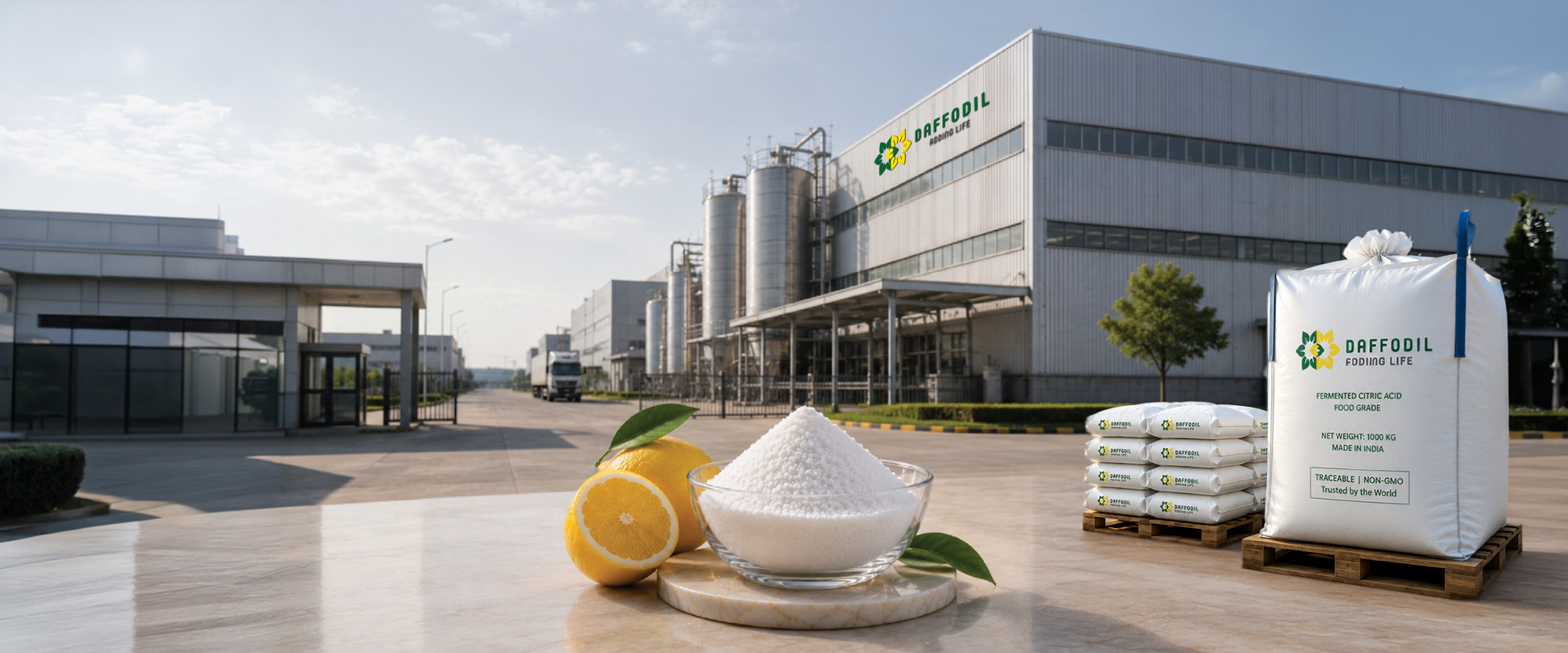
The company’s launch campaign is built around the idea of “A New Source”, positioning its fermented citric acid initiative as a new sourcing destination for the industry. The campaign focuses on reliable supply, trusted quality, manufacturing in India and readiness to serve global markets.
Daffodil already brings decades of experience in citrate manufacturing. Its public company information states that it has manufactured citric acid anhydrous and monohydrate since 2000, while its current portfolio and capabilities span pharmaceutical, food, nutraceutical, healthcare and related applications.
| A CONTROLLED DAFFODIL GLIMPSE
Daffodil is adding a new India-based source of fermented citric acid to this evolving landscape. The launch campaign positions the facility as India’s first and only fermented citric acid manufacturing facility. This document keeps that claim explicitly attributed to the campaign positioning rather than presenting it as an independently verified industry ranking. |
06 THE BIGGER PICTURE
The future of citric acid is also a story about confidence
Citric acid may be a small ingredient in the formulation sheet. But its role in modern manufacturing is much bigger.
It can influence flavour, acidity, stability, formulation performance and processing across industries. And behind every application is a supply chain that has to keep moving.
As manufacturers think more carefully about sourcing, consistency and supply continuity, the question is no longer only:
| “Can I buy citric acid?” It is also: “Can I build confidence around where my citric acid comes from?” |
That is the conversation India’s growing manufacturing capabilities can contribute to. And that is the space Daffodil’s new fermented citric acid initiative is entering.
|
BECAUSE THE FUTURE OF CITRIC ACID IS NOT ONLY ABOUT THE MOLECULE. IT IS ALSO ABOUT THE CONFIDENCE BEHIND ITS SOURCE. |



 English